An AI Sales Concierge is a specialized AI sales agent designed to facilitate and accelerate the sales process. Its capabilities span multiple channels – including website chat, phone, email, WhatsApp, QR codes, kiosks, and campaign landing pages – to:
- Engage inbound prospects
- Qualify buying intent
- Answer common questions
- Book meetings / demos
- Schedule appointments / reservations
- Promote free trials or special offers
It sits between your marketing traffic and your sales pipeline. Instead of sending buyers to a passive form, voicemail, or delayed follow-up, it turns active interest into a real conversation while intent is still high.
This guide explains what an AI Sales Concierge is, how it works, how it differs from AI chatbots and AI SDRs, where it fits best, and what to look for when choosing one.
| Quick definition | The AI Sales Concierge is designed to automatically convert inbound leads. It does this by engaging prospects, assessing their qualification, addressing buyer inquiries, and either scheduling the next step or prompting a sales action. |
|---|---|
| Best for | Businesses that already generate traffic or enquiries and want faster response, better qualification, and fewer missed opportunities. |
| Typical outcome | Teams typically see 3x more qualified leads compared to passive form capture and delayed follow-up. |
| Not the same as | A generic website chatbot that only answers FAQs, or an AI SDR that focuses on outbound prospecting. |
What is an AI Sales Concierge?
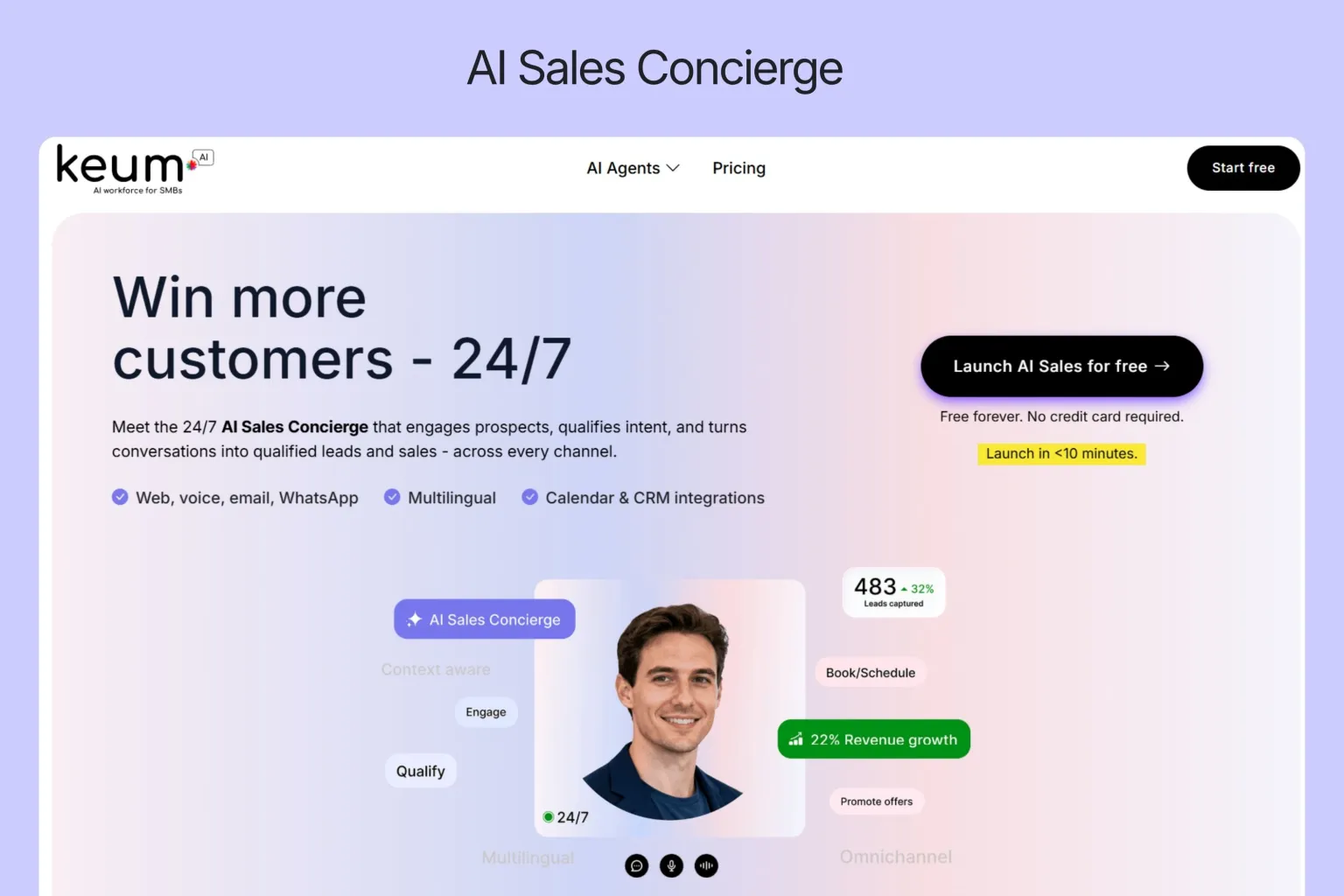
An AI Sales Concierge is a specialised inbound sales agent. Its job is to respond when a prospect shows intent, guide the conversation, collect the right qualification signals, and move the buyer toward a booked meeting or another defined next step.
The word concierge matters. A concierge does not wait silently for a question. It greets, guides, recommends, and arranges what comes next. In a sales context, that means proactive engagement instead of passive lead capture.
In practice, the category combines four capabilities in one layer: conversational engagement, lead qualification, product knowledge, and scheduling or routing. That makes it especially useful for teams that generate demand but cannot respond to every prospect immediately – or who want to ensure every inbound signal is acted on consistently, regardless of channel or time of day.
Who it is for
- Sales and marketing teams with inbound traffic from their website, ads, events, or phone channels.
- Small and midsize businesses that cannot staff a 24/7 response function.
- Revenue teams that want better speed-to-lead, cleaner qualification, and fewer dropped handoffs.
Who it is not for
- Teams looking primarily for outbound prospecting and cold outreach – that is closer to the AI SDR category.
- Sales processes that require every first-touch conversation to be handled manually for policy reasons.
How an AI Sales Concierge works
Most implementations follow the same five-step flow, even if the channel or conversation style changes.
1. Prospect arrives
The trigger can be a website visit, a click on a campaign landing page, an inbound phone call, a WhatsApp message, a reply to an email assistant, or a QR code scan from an event or printed material. Each channel carries a different context — a visitor spending time on a pricing page signals different intent than a caller asking about availability, or a conference attendee scanning a booth banner. The agent uses that context to shape what happens next rather than opening with a generic greeting.
2. The agent engages
Instead of sending the buyer to a form or voicemail, the agent opens a relevant conversation based on where the prospect came from and what they appear to be looking for. A pricing-page visitor might be asked about team size and timeline. A caller asking about a specific service gets a different opening than someone who clicked a general awareness ad. The goal is a contextually relevant response from the first message – not a scripted interaction that ignores the entry point.
3. The agent qualifies
The agent works through your qualification logic – BANT, MEDDIC, or a custom framework – gathering fit, urgency, and readiness signals through natural back-and-forth rather than a static form. It does not interrogate. Lead quality is scored before any human time is spent, so by the time the conversation reaches a booking step or a human handoff, both sides already know whether the fit is strong enough to continue.
4. The agent answers and routes
The agent draws on your approved knowledge base — product documentation, pricing structure, FAQs, competitive positioning — to answer common buying questions accurately and without delay. Where confidence is low, it escalates cleanly rather than improvising. Contact details can be verified at this stage, filtering out invalid emails and phone numbers before they reach your CRM. For qualified prospects, the agent presents live calendar availability and completes the meeting booking in one conversation — no email back-and-forth required.
5. The system updates records
Conversation context, qualification scores, verified contact details, and next-best actions are pushed to your CRM and calendar stack so the handoff starts with context rather than a cold introduction. Your sales rep arrives at the meeting already briefed on what the prospect asked, how they qualified, and what was agreed. Nothing is lost between channels or across working shifts.

Why this matters
The goal is not to replace sales reps. The goal is to remove delays, capture intent earlier, and make sure human sellers spend time on the conversations most likely to move forward.
Core capabilities to look for
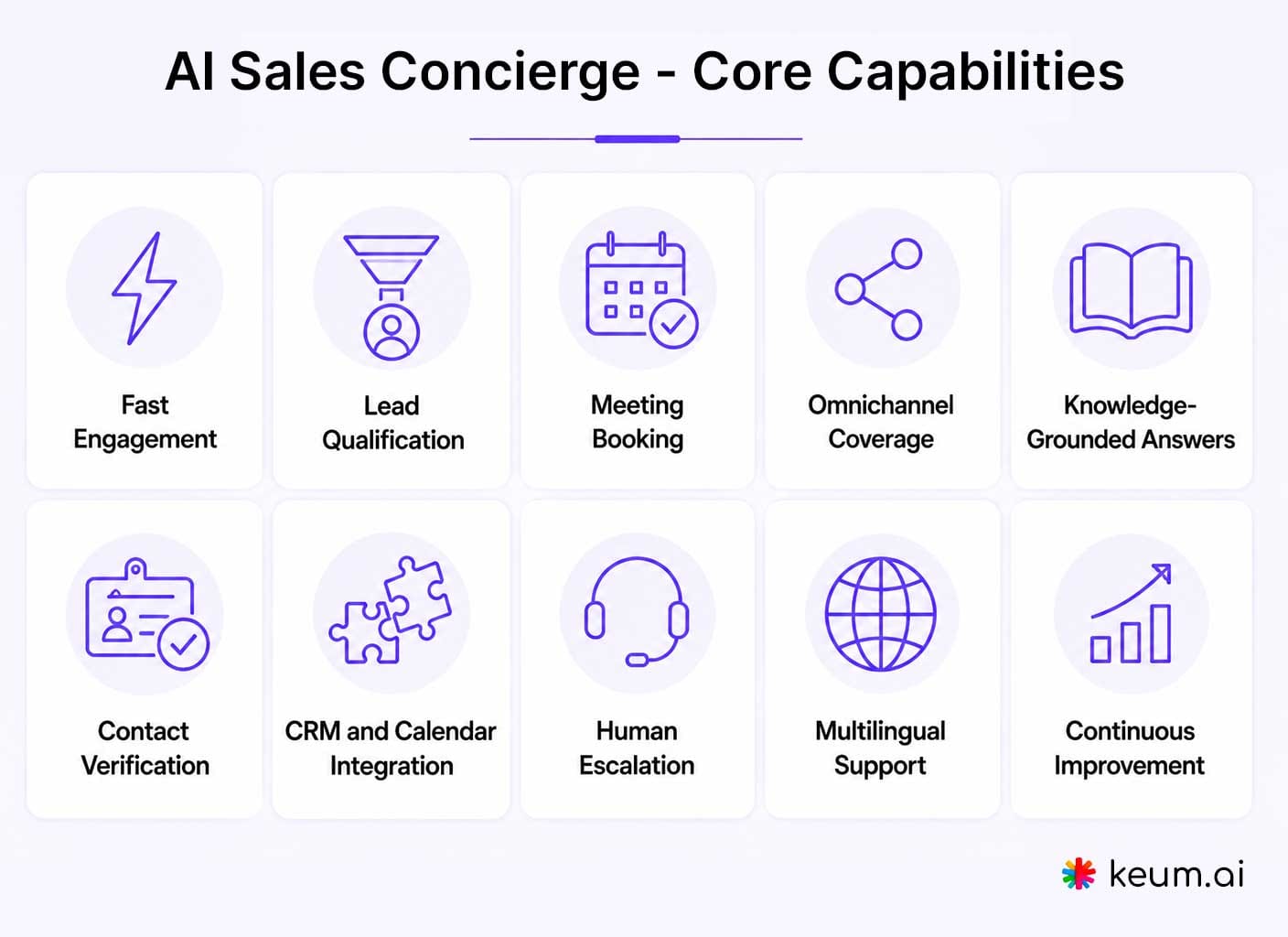
A purpose-built AI Sales Concierge combines several capabilities that basic chatbots and form-capture tools do not. These are the ones that matter most in practice.
- Fast engagement: Prospects receive an immediate response while attention is still high. Studies consistently show that the conversion window for inbound intent narrows significantly within the first few minutes – the agent removes that delay entirely, responding within seconds regardless of the time or channel.
- Lead qualification: The agent gathers fit, urgency, and readiness signals through natural conversation rather than a static form. It can follow BANT, MEDDIC, or a custom qualification framework configured to your funnel, scoring leads automatically before any human time is spent.
- Meeting booking: Qualified buyers can move directly to a calendar slot without waiting for a human to find a time. The agent shows live availability, handles time-zone resolution, and completes the booking in a single conversation – eliminating the back-and-forth that costs conversions at the scheduling stage.
- Omnichannel coverage: The same qualification and booking logic operates across web, voice, email, messaging apps, QR codes, and campaign touchpoints. A lead that starts on your website and continues on WhatsApp maintains full context without needing to start over.
- Knowledge-grounded answers: The agent answers from your approved content – product docs, pricing guides, FAQs, competitive comparisons – rather than generating responses from general knowledge. This keeps answers accurate and within scope, which matters wherever wrong information damages trust or creates compliance risk.
- Contact verification: The agent validates email addresses and phone numbers during the conversation, filtering out junk submissions before they enter your CRM. Verified contacts reach your sales team already cleaned – improving handoff quality, reducing time wasted on bad data, and keeping your pipeline accurate.
- CRM and calendar integration: Qualification details, conversation summaries, and verified contact data flow directly into your CRM and calendar stack after every interaction. Your team receives structured context at the handoff – not a raw transcript – so they arrive at conversations already knowing what was discussed.
- Human escalation: When confidence is low or your process requires a human at a specific point, the agent routes cleanly rather than guessing. Conversation history travels with the handoff so the person taking over does not have to start from scratch.
- Multilingual support: The agent can conduct qualification and booking conversations in multiple languages without requiring separate deployments or dedicated language teams. For businesses serving diverse markets or international audiences, this removes a friction point that would otherwise require additional headcount.
- Continuous improvement: Reviewed conversations feed back into knowledge base updates and qualification logic refinements. The agent improves from real interactions over time, which means performance compounds as the team resolves gaps rather than requiring periodic manual retraining.
AI Sales Concierge vs AI chatbot vs AI SDR
These categories overlap in conversation design but solve different revenue problems. Understanding where each fits prevents buying the wrong tool for the job.
| Area | AI Sales Concierge | AI Chatbot | AI SDR |
|---|---|---|---|
| Primary job | Convert inbound demand | Answer common questions | Create outbound pipeline |
| Typical channels | Web, phone, messaging, email, QR, campaigns | Usually website chat | Email, LinkedIn, outbound sequences |
| Lead qualification | Strong and configurable | Usually limited | Strong for outbound research |
| Meeting booking | Core workflow — books in one conversation | Sometimes, but not always | Common goal of the sequence |
| Multilingual | Yes | Sometimes | Sometimes |
| Contact verification | Yes — filters junk before CRM | Rarely | Varies |
| Best for | Building a net-new pipeline | Handling common FAQs at scale | Building net-new pipeline |
A simple way to think about it: if you already have attention and want to convert it, an AI Sales Concierge is the right fit. If you need to create net-new conversations with people who have never heard of you, you are closer to the AI SDR use case. Most growing businesses eventually need both — but at different stages and for different purposes.
See how keum.ai’s AI Sales Concierge works in practice →
Keum.ai helps teams engage prospects, qualify fit, and move buyers to the next step — across web, phone, WhatsApp, email, QR codes, kiosk deployments, and campaign touchpoints.
Engage prospects, qualify fit, and book meetings automatically — across every channel. Free forever
Best-fit use cases
The strongest use cases usually combine high inbound intent, limited response capacity, and a clear next step such as booking, routing, or qualification. Each of the following industries has a satellite guide covering channel-specific deployment in more depth.
SaaS and B2B software
Qualify trial users, pricing-page visitors, and demo interest before momentum fades.
Professional services
Capture legal, consulting, accounting, and advisory enquiries after hours and route them correctly.
Healthcare and dental
Handle initial intake, treatment questions, and appointment routing without making patients wait.
Real estate and property
Engage buyers or renters immediately, answer listing questions, and schedule viewings.
Home services
Respond quickly to urgent enquiries where response speed often determines who wins the lead. Think HVAC, Plumbing, Pest control, lawn care, etc.
Agencies and service businesses
Turn contact-form traffic and campaign-driven visits into live qualification instead of delayed follow-up.
Events and trade shows
Use QR codes, phone numbers, or landing pages to keep booth traffic from disappearing after the event.
Paid campaigns
Replace passive landing-page experiences with conversational qualification and direct booking.
more qualified leads
Typical outcome for keum.ai customers
Teams using keum.ai’s AI Sales Concierge typically see 3x more qualified leads compared to passive form capture and delayed manual follow-up – by engaging and qualifying intent at the moment it appears, across every channel.
How to evaluate an AI Sales Concierge
- Channel coverage: Does it work only on your website, or across the channels your buyers actually use – phone, messaging apps, email, events, and campaign landing pages? The answer determines whether you are solving a website problem or a full-funnel conversion problem.
- Qualification flexibility: Can you configure the qualification flow to match your process without involving engineering each time your criteria change? Your funnel will evolve, and the tool needs to adapt without friction.
- Knowledge quality: Does the agent answer from approved, bounded sources, or does it draw on general knowledge and risk improvising? In regulated or trust-sensitive industries, knowledge-grounded responses are non-negotiable.
- Booking and routing: Can the agent complete the next step in a single conversation – booking directly into a calendar or routing to the right rep – or does it still depend on manual follow-up to close the loop?
- CRM and calendar integration: Can your team receive structured qualification context at handoff, rather than a raw chat log or nothing? Integration depth determines whether the tool creates efficiency or simply shifts the manual work downstream.
- Escalation design: When the agent reaches the edge of its confidence or knowledge, does it route cleanly to a human or does it improvise? Escalation quality is often the deciding factor for trust in AI-assisted sales workflows.
- Speed to launch: Can a lean team configure, test, and improve the agent without ongoing engineering support? Long implementation timelines shift the value window from days to months.
Frequently asked questions
What is an AI Sales Concierge?
It is an AI sales agent designed to convert inbound interest into qualified next steps by engaging prospects, asking qualification questions, answering common buying questions, handling objections, and booking or routing the conversation with context.
How is it different from an AI chatbot?
A chatbot often focuses just on answering questions. An AI Sales Concierge is more workflow-oriented and designed for sales outcomes: it is built to guide, qualify, convert, route, and book — not just respond. The workflow could be rigid and rule based (old school) or the AI agent manages it autonomously without needing any strict rules or paths.
How is it different from an AI SDR?
An AI SDR is usually outbound-first. An AI Sales Concierge is inbound-first and is used to convert the demand you have already generated, not to create net-new cold outreach.
Can it replace a human sales rep?
Not fully, and that is not the point. It handles first-touch work and repetitive qualification so human reps can focus on higher-value conversations where judgment, relationship, and negotiation actually matter.
Which channels does it support?
keum.ai’s AI Sales Concierge works across web chat, phone, WhatsApp, email, QR codes, and kiosk deployments — covering both digital channels and offline touchpoints like events, printed materials, and physical locations. Conversations maintain context across channels, so a prospect who starts on your website can continue on WhatsApp without starting over.
Is it suitable for startups and SMBs?
Yes. Startups and SMBs often benefit the most because they have the least capacity to respond to every lead quickly and consistently. An AI Sales Concierge gives a small team the response coverage of a much larger one.
What should happen when the AI is unsure?
It should escalate or route for human review rather than improvise. Good sales automation protects trust as much as it improves speed — a wrong answer about pricing or availability is more damaging than a short delay. Keum handles it perfectly.
What should I measure after launch?
Start with response time to first contact, qualified lead rate, meeting booking rate, contact verification quality, and handoff quality into your CRM and calendar. These five metrics tell you whether the agent is improving or just adding activity.
About this guide
This article was authored and reviewed by the keum.ai product team and written to help buyers understand where an AI Sales Concierge fits in the modern revenue stack of startups and SMBs.
It is intended as an educational guide first and a product-led buying resource second. If you are evaluating platforms, use them alongside a real product trial, demo, your qualification requirements, and your integration checklist.
Ready to stop losing inbound intent?
Keum.ai helps teams engage prospects, qualify fit, and move buyers to the next step — across web, phone, WhatsApp, email, QR codes, kiosk deployments, and campaign touchpoints.
Free forever, no credit card required.