Note: AI lead generation is a broad category term that uses AI to identify, engage, qualify, and convert potential customers. In this article, we focus on inbound AI lead generation — where an AI agent engages prospects in real time, qualifies intent, verifies contact details, and routes or books them automatically for next best action.
AI lead generation is the use of intelligent software agents to automatically engage inbound prospects, qualify their intent, and capture verified contact details — replacing or enhancing passive form submissions with real-time conversations that convert interest into pipeline while it is still active.
Rather than routing visitors to a passive contact form, hoping for visitors to fill their details and then waiting for a follow-up email, these tools engage within seconds, ask structured qualification questions, and route or book the prospect before attention fades. The model is conversational, contextual, and continuous — running across web, phone, messaging apps, and campaign touchpoints around the clock.
This guide explains how the model works, why it consistently outperforms traditional form capture, and what to look for when evaluating tools.
| Quick definition | AI lead generation uses intelligent agents to engage, qualify, and capture inbound prospects automatically — across web, phone, messaging, and campaign channels. |
|---|---|
| Best for | Businesses generating inbound traffic that want faster speed-to-lead, better-qualified contacts, and fewer dropped leads. |
| Not the same as | A static contact form, a basic chatbot that only answers FAQs, or an outbound prospecting tool. |
What is AI lead generation?

AI lead generation — often referred to as automated lead generation — describes the full process of identifying, engaging, and qualifying prospects using artificial intelligence, from the moment someone shows interest to the point where a verified, qualified contact is ready for a sales conversation.
The traditional alternative is a form: a prospect fills in their name, email, and company, submits, and waits for a follow-up that may be reviewed by a human sales rep hours or days later. By then, intent has often faded. The prospect has moved on, spoken to a competitor, or simply lost the urgency that brought them to you.
The AI model changes that timing entirely. Instead of capturing data passively and acting later, it engages immediately — opening a relevant conversation based on where the prospect came from, which page they landed on, or which campaign they clicked. The agent then works through a qualification logic — BANT, MEDDIC, or a custom framework — gathering fit and readiness signals through natural dialogue rather than interrogation.
The category sits at the intersection of conversational AI, sales qualification, and pipeline automation. An AI Sales Concierge is the most common implementation: a purpose-built inbound agent that engages, qualifies, and routes or books prospects across every channel where demand appears.
Who it is for — and who it is not for
The approach works best when:
- You generate inbound traffic from your website, paid campaigns, events/conferences, or phone channels and want to act on it faster.
- Your team cannot respond to every lead immediately — especially outside business hours.
- You want qualified, verified inbound leads arriving directly in your CRM — not raw form submissions your reps have to sort through manually.
- You need consistent qualification across multiple channels without hiring for each one.
It is not the right fit when:
- Your primary need is outbound prospecting and cold outreach — that is closer to the AI SDR category.
- All first-touch conversations must be handled by a human for legal or compliance reasons.
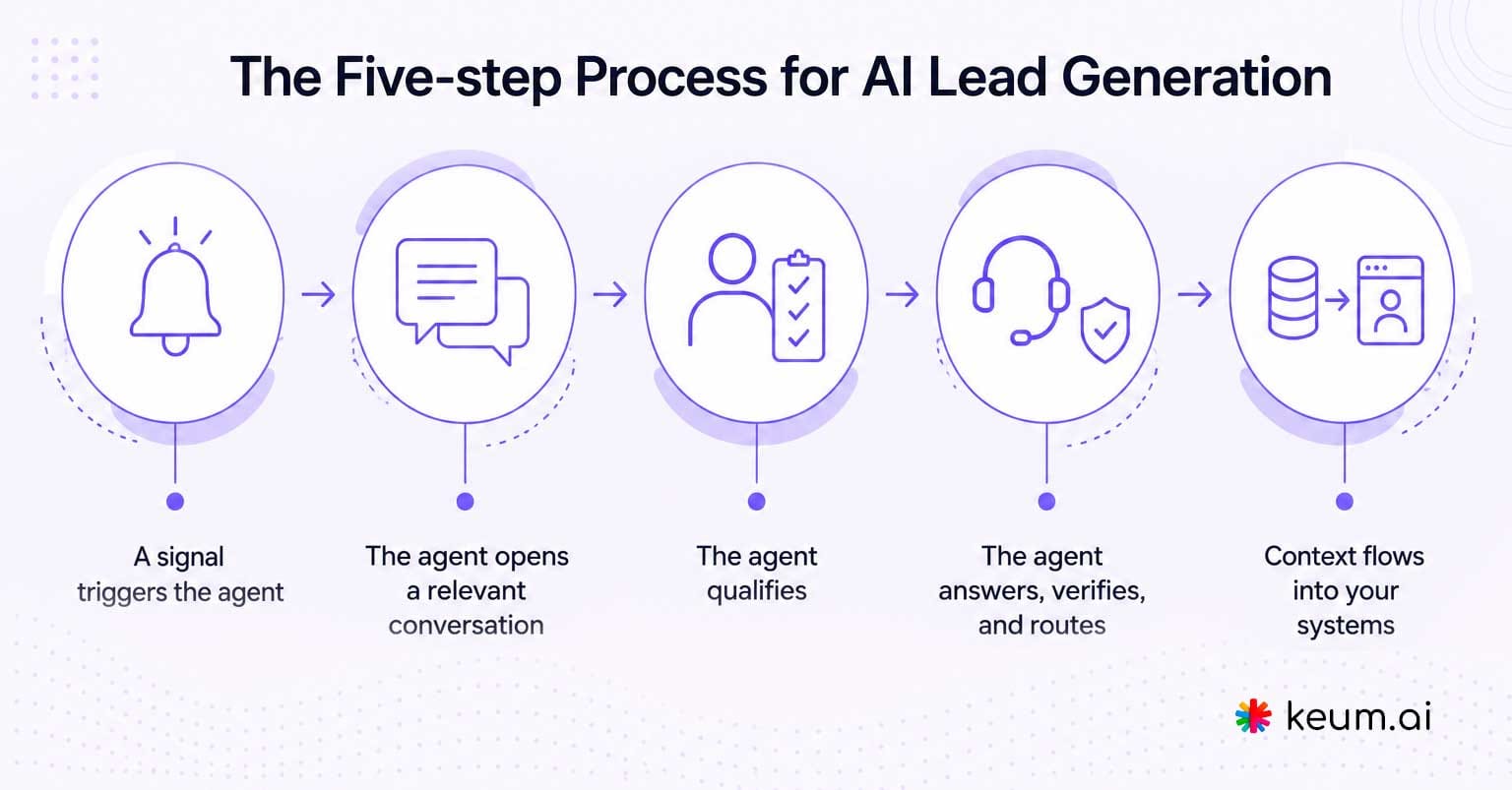
How it works: the five-step process
Most implementations follow a five-step sequence, regardless of channel.
Step 1: A signal triggers the agent
The entry point might be a visit to a pricing page, a click on a campaign landing page, an inbound call, a WhatsApp message, or a QR code scan at a trade show. Each signal carries intent context. A visitor spending four minutes on a pricing page signals different readiness than someone who bounced from the homepage. The agent uses that context to shape what comes next.
Step 2: The agent opens a relevant conversation
Instead of presenting a form or directing the prospect to voicemail, the agent starts a conversation calibrated to the entry point. A pricing-page visitor might be asked about team size and timeline. A caller asking about a specific service hears a different opening than someone who clicked a general awareness ad. The goal is a contextually relevant engagement — not a scripted interaction that ignores why the person arrived.
Step 3: The agent qualifies
Qualification logic runs through natural conversation — not a static checklist. Common frameworks like BANT (Budget, Authority, Need, Timeline) and MEDDIC (Metrics, Economic Buyer, Decision Criteria, Decision Process, Identify Pain, Champion) can be configured to match how your sales team thinks about fit. Lead quality is assessed before any human time is spent.
Step 4: The agent answers, verifies, and routes
Qualified prospects can have their contact details verified during the conversation — filtering out invalid emails and phone numbers before they enter the CRM. Common buying questions are answered from an approved knowledge base. Where confidence is low, the agent escalates cleanly. For qualified prospects with high intent, the agent presents live calendar availability and books a meeting directly in a single conversation.
Step 5: Context flows into your systems
Qualification scores, verified contact details, conversation summaries, and agreed next steps push to your CRM and calendar — HubSpot, Salesforce, Zoho, Google Calendar, Outlook, Calendly, and others — so the handoff starts with context rather than a cold introduction. The sales rep arrives already briefed.
Why conversational AI lead generation outperforms forms
The performance gap comes down to one key variable: timing. A contact form captures data and schedules a conversation for later. Conversational AI lead generation has that conversation now — while the prospect is still on the page, still engaged, and still ready to move.
According to the Salesforce State of Sales 2026, slow response to inbound enquiries ranks among the top three sources of pipeline leakage cited by sales leaders. High-performing teams are significantly more likely to respond within the first five minutes of a prospect making contact. Speed-to-lead is not a courtesy — it is a conversion variable.
The table below summarises the practical difference:
| Lead capture form | Conversational AI lead generation | |
|---|---|---|
| Response time | Hours to days after submission | Seconds — 24/7, regardless of volume |
| Qualification | Manual, done by a rep after the fact | Automated in the same conversation using BANT or MEDDIC |
| Contact verification | None — junk data enters the CRM | Emails and phone numbers validated before CRM entry |
| Meeting booking | Requires separate follow-up steps | Booked directly in one conversation |
| Channel coverage | Usually website only | Web, phone, WhatsApp, email, QR codes, campaigns |
| Drop-off risk | High — intent fades during delay | Low — prospect is engaged while intent is live |
The result is not just faster response — it is a structurally different pipeline. Leads that come through a conversational flow arrive pre-qualified, with verified contact details, a meeting already booked, and context loaded into your CRM. Leads that come through a form arrive as raw data, requiring manual qualification, follow-up, and verification before any sales conversation can begin.
Key capabilities to look for
Not every tool in this category offers the same depth. A basic chatbot answers questions and collects contact details. A purpose-built AI lead generation system goes further: it qualifies intent, (using BANT or MEDDIC), verifies contacts in real time, books meetings into your calendar, and pushes structured handoff data to your CRM — all without human involvement.
Immediate engagement
A purpose-built agent responds in seconds regardless of the time of day or the volume of incoming enquiries — removing the speed-to-lead gap entirely.
Structured qualification
The agent gathers fit, urgency, and readiness signals through natural back-and-forth rather than a static form. Whether the framework is BANT, MEDDIC, or a custom flow built around your funnel, qualification happens before human time is spent — and the signal quality is documented in the CRM rather than lost in an inbox.
Contact verification
Invalid email addresses and disconnected phone numbers are filtered out during the conversation, before they reach your pipeline. Verified contacts arrive at your team already cleaned, improving handoff quality and keeping data accurate.
Omnichannel coverage
The same qualification and routing logic should operate across phone, WhatsApp, email, QR codes from events, and campaign landing pages — so no channel becomes a dead end for inbound demand.
Meeting booking
Qualified buyers can move directly to a calendar slot without waiting for a human to find a time. The agent handles time-zone resolution, confirms the booking, and pushes it to your calendar stack.
CRM and calendar integration
Qualification context flows to your systems as structured data — not a raw transcript. Integrations with HubSpot, Salesforce, Zoho, Google Calendar, Outlook, and Calendly turn every conversation into a clean, contextualised handoff.

See how keum.ai generates leads automatically →
Engage, qualify, and book inbound prospects across every channel – free forever, no credit card required.
Where it fits best
The strongest use cases combine high inbound intent, limited response capacity, and a clear next step such as a booked meeting, a routed enquiry, or a verified contact.
SaaS and B2B software
Pricing-page visitors and demo requests represent high intent. Engaging and qualifying them immediately — rather than sending them to a form and following up the next business day — narrows the gap between intent and conversation before competitors can fill it.
Professional services
Legal, accounting, consulting, and advisory firms generate enquiries outside business hours that current staff cannot respond to in real time. In a typical deployment scenario, a consulting firm receiving 25 enquiries per week — most arriving outside office hours — sees its qualified lead rate climb significantly once a conversational agent handles triage and qualification around the clock. Every contact arrives verified, with context loaded into the CRM before a rep ever opens the file.
Healthcare and dental
Patient enquiries often require specific routing — to the right provider, service, or appointment type. Conversational intake that qualifies before booking reduces the manual triage front-desk teams handle repeatedly, and ensures no enquiry is left unanswered after hours.
Home Services
Plumbers, electricians, HVAC contractors, and landscapers operate in a category where response speed often determines who wins the job. A homeowner with an urgent repair need will call two or three providers and book the first one that responds. A conversational agent that answers immediately, qualifies the job type and location, and books a site visit or callback — even at 10pm — removes the gap that lets a competitor in first.
Real estate and property
Buyers and renters showing interest in a listing want a fast response. A conversational agent can answer listing questions, qualify timeline and budget, and schedule a viewing — often before the prospect has had time to enquire elsewhere.
Events and paid campaigns
Traffic from trade shows, events, and paid campaigns carries high intent and short attention spans. Replacing a passive landing-page form with a conversational qualification flow — or following up a QR code scan (printed on booth signage) with an immediate message — captures contacts that would otherwise disappear.
keum.ai’s AI Sales Concierge covers each of these scenarios from a single deployment — web chat, phone, WhatsApp, QR codes, and campaign landing pages — without requiring a separate configuration per channel.
How to evaluate an AI lead generation tool
Response speed. Speed-to-lead matters most on inbound intent — every additional minute of delay narrows the conversion window significantly. Does the tool respond within seconds across every channel, or does it still depend on a human to review and reply?
Qualification flexibility. Can the qualification logic be configured to match your framework — BANT, MEDDIC, or a custom flow — without engineering involvement each time criteria change? The tool should adapt to your funnel, not the other way around.
Channel coverage. Does the tool work only on your website, or across the channels your buyers actually use? Phone, WhatsApp, email, QR codes from events, and campaign landing pages each carry different buyer contexts and intent signals.
Knowledge accuracy. Does the agent answer from approved, bounded content — your product documentation, pricing guides, FAQs — or from general knowledge that may be wrong? In trust-sensitive sales conversations, a wrong answer about pricing or availability is more damaging than a short delay.
Integration depth. Can qualification context and verified contacts push to your CRM and calendar as structured data ready for your team to act on? Integration quality determines whether the tool creates efficiency or simply shifts manual work downstream.
Speed to launch. Can a lean team configure, test, and deploy the agent without engineering support? Long implementation timelines shift value from weeks to months.
If you want a benchmark for what good looks like in practice: teams using keum.ai’s AI Sales Concierge typically see 3x more qualified leads compared to passive form capture and delayed follow-up, by engaging and qualifying intent at the moment it appears — across every channel.
Frequently asked questions
What is AI lead generation for inbound?
AI lead generation is the use of intelligent agents to automatically engage inbound prospects, qualify their fit and intent through natural conversation, and capture verified contact details — replacing passive form submissions with real-time interactions that convert interest into pipeline while it is still high.
How does AI lead generation work?
An AI sales agent responds to an inbound signal — a website visit, phone call, WhatsApp message, or QR scan — with a contextually relevant conversation. It works through a qualification framework such as BANT or MEDDIC, answers common buying questions, verifies contact details, and routes the prospect or books a meeting directly in one conversation.
Is AI lead generation better than forms?
For most inbound use cases, yes. Passive lead capture via forms depends on delayed follow-up, by which point intent has often faded. The conversational approach responds immediately, qualifies in real time, and routes or books the prospect in one conversation — resulting in more qualified contacts and fewer dropped leads.
What tools are used for AI lead generation?
Common categories include AI Sales Concierge platforms, conversational AI agents, and AI chatbots. The distinction matters: a chatbot primarily answers questions, while a purpose-built AI Sales Concierge covers qualification, contact verification, meeting booking, and CRM integration across multiple channels.
How do I measure AI lead generation ROI?
Start with five metrics: response time to first contact, qualified lead rate, meeting booking rate, contact verification quality, and handoff quality into your CRM. These tell you whether the agent is improving pipeline quality or just adding activity. Comparing them against your pre-deployment baseline gives a clear ROI signal within the first 30 days.
Start free – Deploy AI Sales Concierge in under 10 minutes
Join teams across SaaS, professional services, real estate, home services and healthcare already using keum.ai to engage prospects, qualify fit, and book meetings automatically. No credit card required.