An AI Receptionist is an AI-powered inbound agent that answers every call, message, and walk-in contact automatically – greets callers, qualifies their enquiry, routes or transfers them to the right person or department, books appointments, takes messages, and escalates with full context – across phone, WhatsApp, web, email, QR codes, and kiosk.
In simple terms:
Think of it as a front desk that never takes a day off, never puts a caller on hold, and never sends anyone to voicemail. It answers, qualifies, books, routes, and escalates – without a human in the loop unless one is genuinely needed.
| Quick definition | An AI Receptionist answers every inbound call, message, or walk-in contact automatically – greets callers, qualifies their need, routes or transfers them to the right person, books appointments, takes messages, and escalates with full context. All without a human at the front desk. |
|---|---|
| Best for | Businesses with inbound call and message volume – from solo operators to growing SMBs – that want 24/7 coverage without staffing a front desk. keum.ai’s AI Receptionist starts with a full 30-day free trial including a US phone number. Plans cost less than $30/month. |
| Typical outcome | keum.ai’s AI Receptionist reduces missed calls by up to 90% and handles 100+ concurrent calls simultaneously – so fewer than 1 in 10 callers reaches voicemail and no peak period creates a queue. |
| Not the same as | A basic voicemail system or IVR (“Press 1 for Sales”). An AI Receptionist understands natural language, retrieves context, books appointments in real time, and escalates with full conversation history attached. |
What is an AI Receptionist?
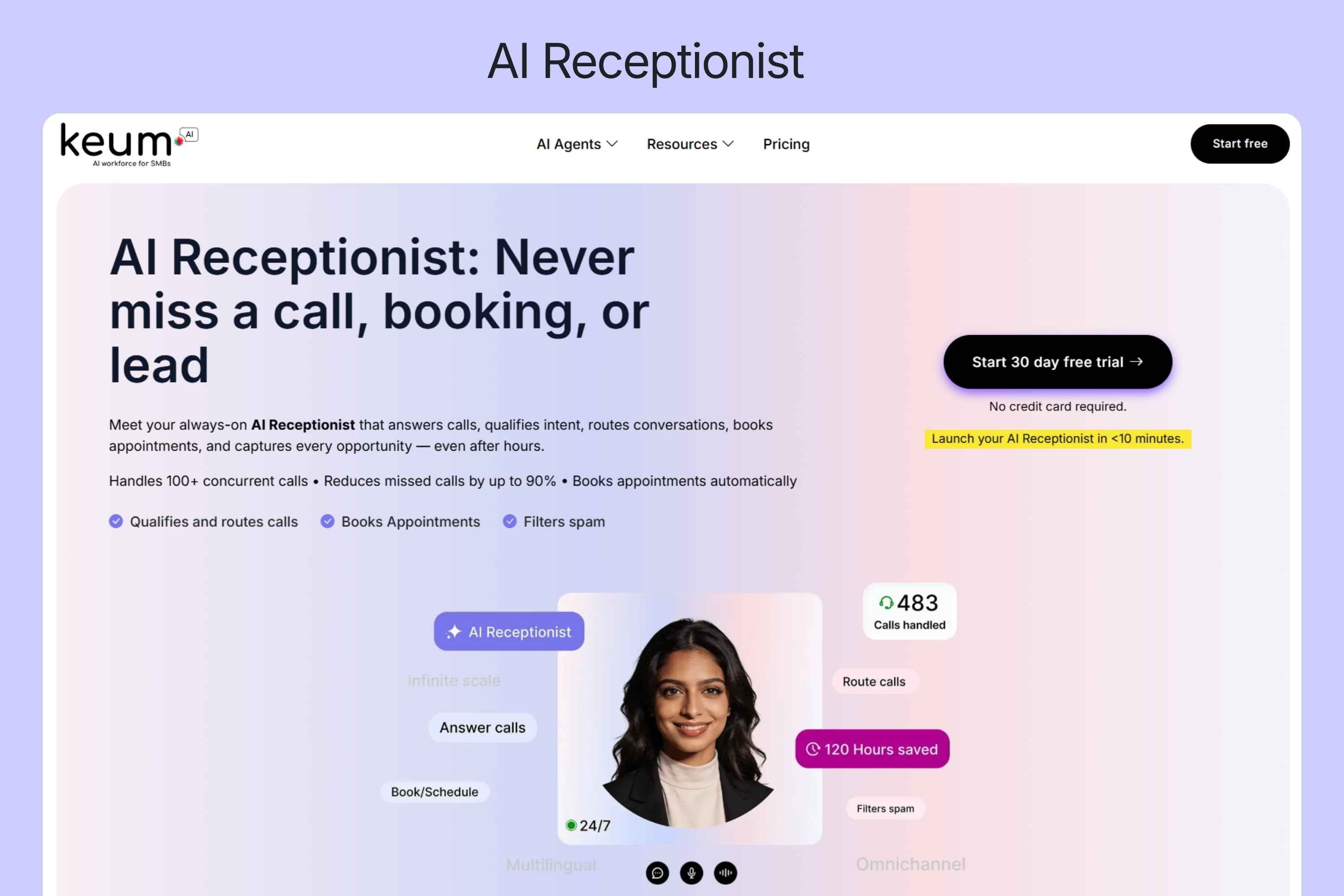
Every business with inbound calls has a revenue entry point: the moment a potential customer makes contact. That contact is already high-intent – the person is past awareness, past consideration, and actively reaching out. What happens next determines whether that intent converts to a booking, a job, a case, or a sale. A missed call, a phone menu that frustrates, or a voicemail nobody checks is not just a customer service failure – it is a revenue event that went the wrong way. An AI Receptionist is, at its core, a system for ensuring every high-intent inbound contact is captured, qualified, and routed toward a concrete outcome rather than lost to voicemail or a competitor who picked up.
According to Salesforce’s State of Service report, 88% of customers say the experience a company provides is as important as its products or services. For most businesses, that experience begins with a single moment: whether the phone gets answered.
An AI Receptionist is a specialised inbound contact agent. Its job is to respond the moment a caller or visitor makes contact, understand their need, draw on your approved knowledge base and connected systems, and either resolve the interaction immediately or route it to the right person with full context.
The word receptionist is deliberate. A receptionist does not forward every call blindly or send callers to voicemail. In a front-desk context, that means active handling – not passive capture.
Most businesses searching for an AI phone agent find tools that handle one job: either answering calls, or booking appointments, or routing enquiries. An AI Receptionist is the full-stack version: live system integration, natural-language understanding, appointment booking, intelligent routing, context-rich escalation, and CSAT tracking in a single deployment – complete front-desk automation from first contact to resolution.
According to BrightLocal’s Local Consumer Review Survey, 62% of smartphone users call a business directly from search results – making inbound phone the single highest-intent customer touchpoint for most local and service businesses. Businesses that fail to answer lose an estimated 30–60% of those callers to a competitor who does.
What problems does an AI Receptionist solve?
A dental practice misses a call during a patient session. A law firm’s Friday enquiry line rings out. A plumber’s phone goes to voicemail mid-job. In each case the caller doesn’t leave a message – they call the next business on the list. That is the missed-call problem: not an administrative inconvenience but a daily revenue leak, with 30–60% of unanswered callers going directly to a competitor who picked up. The flip side is just as damaging. The average business receives dozens of spam, robocall, and junk calls every week – each one answered by a staff member, each one eating time that should go to real customers. An AI Receptionist closes both gaps simultaneously: it answers every genuine contact the moment it arrives and filters junk before it reaches anyone.
Who it is for
- Businesses with inbound call and message volume across phone, WhatsApp, web, email, QR codes, or in-person kiosk channels
- Small and midsize businesses that cannot staff 24/7 front-desk coverage – keum.ai deploys in under 10 minutes, requires no developer, and offers a full-featured 30-day free trial including a US phone number
- Teams that want to eliminate missed calls, automate appointment booking, and free staff for high-value client interactions
- Businesses operating across multiple languages, locations, or time zones needing consistent call quality
Who it is not for
- Teams looking primarily for inbound support ticket resolution – that is the AI Support Concierge category
- Organisations that only need outbound dialling or sales cadences without inbound reception capability
- Processes where every first-touch call must be answered by a named human agent for regulatory reasons
- Very low-volume businesses receiving fewer than 5–10 inbound contacts per week – at that scale, the setup and maintenance effort outweighs the return
How an AI Receptionist works
Every inbound contact follows the same five-step flow regardless of channel.
1. The contact arrives
The trigger can be an inbound phone call, a WhatsApp message, a web chat opening, an email, a QR code scan, or a kiosk tap. The AI Receptionist activates the moment contact is made – using the entry channel and opening query to begin a contextually relevant greeting rather than a generic script.
2. The agent greets and qualifies
Rather than routing the contact to a hold queue, the AI Receptionist greets the caller professionally and asks a precise qualifying question. An appointment enquiry gets a different response path than a billing question or an urgent maintenance call. The goal is to understand the caller’s need accurately from the first exchange.
3. The agent acts
Action works at three levels. For knowledge-based enquiries – opening hours, pricing FAQs, service information – the agent answers directly from your approved knowledge base. For appointment-related contacts, the agent connects to your calendar integration (Google Calendar, Outlook, Calendly, or Cal.com) and books, confirms, or reschedules the appointment in real time during the same conversation. For account-specific enquiries, it retrieves live data from your CRM or operational system. The majority of inbound contacts are resolved or acted on at this stage without any human involvement.
4. The agent routes or escalates with context
When a human is required – an urgent matter, a sensitive query, or a contact outside the AI’s defined scope – the agent hands off with the full conversation history and a structured context bundle attached. The person receiving the call or message arrives briefed, not starting from scratch. Live call and chat handoff is available for real-time transfer where required.
5. The system records and improves
After each resolved interaction, CSAT is collected automatically and the conversation summary pushes into your CRM. Gaps in the knowledge base surface in the receptionist dashboard for one-click human review and approval – so the same gap never costs a caller twice.

The goal is not to replace the people at your front desk – it is to answer the contacts that do not require them, so the staff you have can focus on complex interactions, relationship-critical conversations, and high-value client work.
Up to
100%Missed calls reduced
keum.ai’s AI Receptionist answers every inbound call, message, and walk-in contact automatically – reducing missed calls by up to 100% and handling 100+ concurrent calls simultaneously with no queues and no busy signals..
Before and after: what changes
| Without an AI Receptionist | With keum.ai’s AI Receptionist |
|---|---|
| Callers reach voicemail outside business hours | Every call answered 24/7 across every channel |
| Staff juggle the phone, the front desk, and ongoing work simultaneously | AI handles all inbound contacts; staff focus on in-person and high-value interactions |
| Appointment booking requires a back-and-forth call or a redirect to an online form |
Appointments booked in real time during the same call or message thread |
| Callers transferred cold with no context for the receiving team member | Escalations arrive with full conversation history and a structured context bundle |
| CSAT tracked separately or not at all | CSAT collected automatically after every resolved interaction |
| Staff answer dozens of spam, robocall, and junk calls every week | AI identifies and filters junk calls before they reach anyone – staff time goes to real customers only |
| Peak call periods create hold queues and missed calls | 100+ concurrent calls handled simultaneously – no queues, no busy signals |
Core capabilities
A purpose-built AI Receptionist combines capabilities that generic phone systems and answering services do not. These are the ones that determine quality in practice.
24/7 inbound coverage with no missed calls
The AI Receptionist answers every inbound contact the moment it arrives – whether that is 9 am on a Tuesday or 11 pm on a Sunday. Calls that would previously reach voicemail, a busy signal, or an unanswered WhatsApp thread are handled immediately. keum.ai reduces missed calls by up to 90% and handles 100+ concurrent calls simultaneously, so peak periods never create a queue.
Natural-language call handling
The agent understands what callers say in their own words – not just pre-defined menu options. A caller who says “I need to change my appointment” gets a different response path than one who says “I have a billing question”. This is the difference between an AI Receptionist and a press-1 IVR system.
Real-time appointment booking
The appointment booking capability is what separates a receptionist from an answering service. When a caller wants to book, confirm, or reschedule an appointment, the AI Receptionist connects directly to Google Calendar, Outlook, Calendly, or Cal.com and completes the booking during the same conversation. The caller does not get redirected to a website or told to call back. The appointment is confirmed in real time before the interaction ends.
Intelligent call routing and department transfer
The agent qualifies the nature of each contact and routes to the right person, team, or department – based on topic, urgency, and your defined routing logic. Sales enquiries route to the sales team. Urgent maintenance calls escalate immediately. Routine billing questions get an answer from the knowledge base. Each route carries full context.
Message taking
For contacts where the appropriate person is unavailable, the agent takes a structured message – capturing the caller’s name, number, the nature of their enquiry, and any relevant context – and pushes it directly into your CRM or designated inbox. No pad-and-pen, no lost Post-it notes.
Spam and junk call filtering
The average business receives between 20 and 50 spam, robocall, and telemarketing calls per week. Each one a human receptionist answers is time taken from a real customer. The AI Receptionist identifies and filters junk calls before they reach anyone – qualifying the intent of every inbound contact and terminating or deflecting calls that do not meet a genuine enquiry threshold. For businesses in high-spam industries like home services, financial services, and real estate, this alone saves several hours of staff time every week. Contact verification also runs during every interaction – validating that phone numbers and email addresses are real before they enter your CRM.
Knowledge-grounded answers
The agent answers only from your approved sources – product documentation, SOPs, FAQs, plain-text uploads, and website content – never from general web knowledge. For healthcare, legal, and financial services, this is essential: every answer stays accurate, consistent, and within compliance scope.
Omnichannel coverage
The same greeting, routing, and escalation logic operates across phone, WhatsApp, web chat, email, QR codes, and kiosk deployments. A caller who starts on the phone can follow up on WhatsApp without repeating themselves – full context travels with them across channels.
Escalation with context
When a human is required, the AI Receptionist routes with the full conversation history and a structured context bundle attached. The receiving team member arrives already briefed. Live call and chat handoff moves conversations instantly for teams requiring real-time transfer.
CSAT scoring
Customer satisfaction is collected automatically after every resolved interaction – no separate survey tool, no manual follow-up. CSAT scores sit alongside call volume, routing outcomes, and escalation rate in the receptionist dashboard.
Receptionist dashboard
Call volume, routing outcomes, resolution rates, CSAT scores, and escalation rate in a single real-time view. Weekly review identifies the knowledge gaps and routing rules most worth improving first.
CRM and calendar integration
Conversation summaries, CSAT scores, contact details, and booking confirmations push directly into HubSpot, Salesforce, Zoho, Freshdesk, or Zendesk after every interaction. Appointments sync to Google Calendar, Outlook, Calendly, or Cal.com in real time during the conversation.
Continuous learning with human-in-the-loop training
When the agent cannot answer with confidence, it flags the gap for human review. One click updates the knowledge base and the fix goes live immediately – approved by a human before it reaches the next caller. Every resolved gap improves future responses.
Multilingual support
The agent serves callers in their preferred language without separate deployments – covering digital channels and in-person kiosk touchpoints in a single configuration.
AI Receptionist vs answering service vs IVR system
These categories share the goal of handling inbound contacts but solve the problem in fundamentally different ways.
| Area | AI Receptionist | Human answering service | IVR system |
|---|---|---|---|
| Primary job | Greet, qualify, route, book, message, and escalate automatically | Human agents answer calls during staffed hours | Route callers through a menu tree – no understanding of natural language |
| Channels | Phone, WhatsApp, web, email, QR, kiosk | Phone only (most providers) | Phone only |
| Hours | 24/7 with no out-of-hours premium | Limited to staffed hours or costly after-hours rates | 24/7 but passive – cannot resolve or book |
| Appointment booking | Real-time booking in the same conversation | Can book if staffed; often redirects to online form | Cannot book – routing only |
| Natural language | Full NLU – understands callers in their own words | Human agent understands naturally | Menu-driven – “Press 1 for Sales” |
| Cost model | Usage-based AI credits; free 30-day trial | Per-minute or per-call human agent cost | Included in phone system cost – limited capability |
| Consistency | Same quality on every call, 24/7 | Varies by agent, shift, and call volume | Consistent routing; zero resolution capability |
| Scalability | 100+ concurrent calls with no degradation | Degrades at peak; hold queues form | Routes concurrently but cannot resolve |
| Spam filtering | Screens caller intent – junk, robocall, and telemarketing calls filtered before reaching staff | Human agents answer every call including junk – each one costs per-minute billing | No screening – every robocall answered and forwarded |
| CRM integration | Native push to HubSpot, Salesforce, Zoho, Freshdesk, Zendesk | Manual logging or basic integration (varies by provider) | None – routing data only |
| CSAT tracking | Built in – collected automatically after each interaction | Rarely built in | Not applicable |
The right mental model:
An AI Receptionist replaces the mechanical parts of front-desk work – greeting, routing, booking, messaging – so your human team handles what requires genuine judgement, empathy, and relationship management.
See how keum.ai’s AI Receptionist works in practice →
Free 30-day trial · Includes a free US phone number · Less than $30/month · Deploy in under 10 minutes
Best-fit use cases
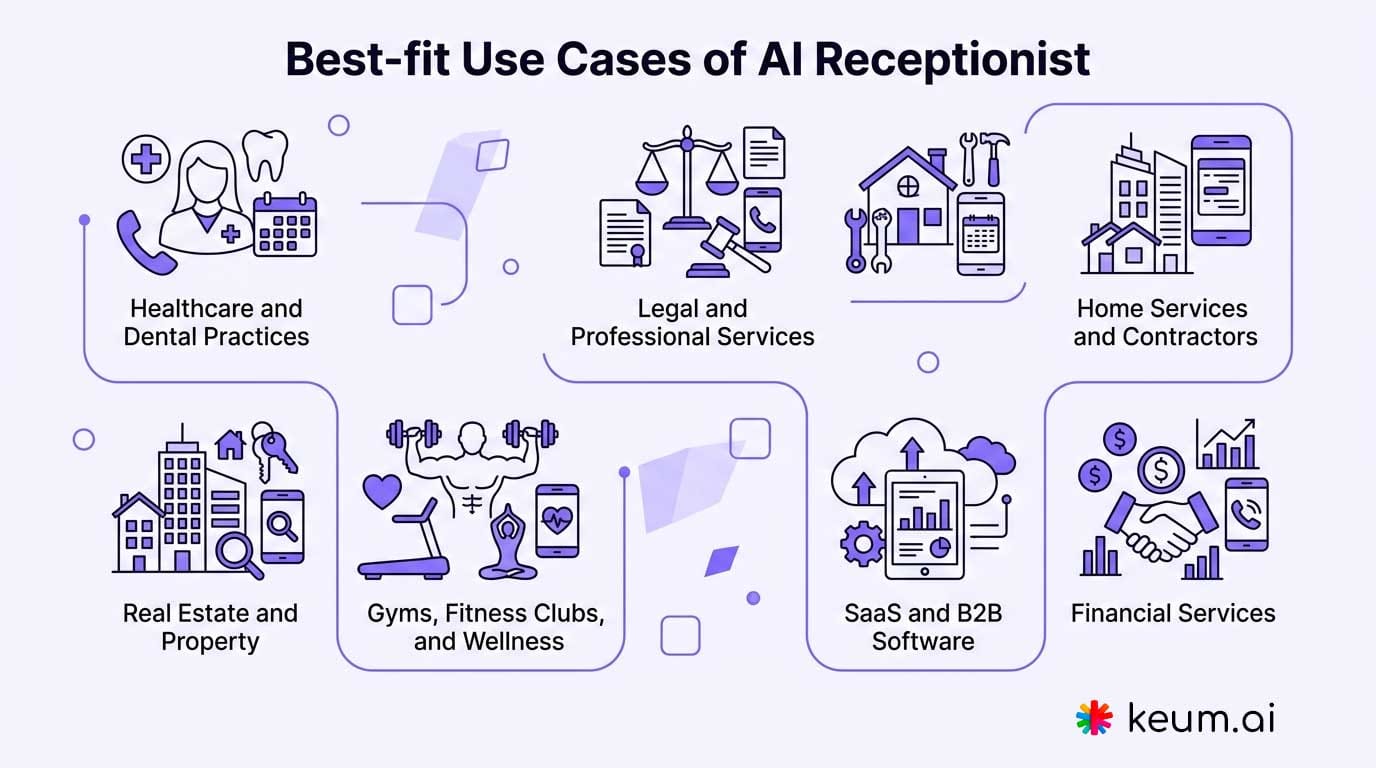
The strongest use cases share three characteristics: meaningful inbound call or message volume, limited reception capacity, and a clear definition of what a handled contact looks like.
Healthcare and dental practices
A busy dental practice misses 30+ calls a week during chair time. After deploying an AI Receptionist: every patient call answered immediately, appointments booked in real time, zero after-hours voicemails. Handle patient appointment enquiries, billing questions, and treatment FAQs within a compliance-safe knowledge boundary. A significant proportion of appointment requests in healthcare arrive outside business hours – the AI Receptionist covers that window without out-of-hours staffing costs.
Legal and professional services
A law firm loses new client enquiries every Friday evening when the office closes. After deploying: every after-hours call qualified, initial consultation booked automatically, fee earner briefed before Monday. The agent answers client intake calls and process questions around the clock, routes new client calls for follow-up, takes structured messages, and escalates urgent matters with full context. Every answer stays within the compliance-approved knowledge boundary.
Home services and contractors
A plumber on a job site misses six calls on a Tuesday morning – four go to competitors, two leave no message. After deploying: every inbound call answered, jobs booked in real time, urgent callouts escalated to the engineer’s mobile immediately. Job enquiries, quote requests, warranty questions, and callback requests are handled automatically across phone and WhatsApp, so no inbound enquiry is lost during a busy service day.
Real estate and property
A property agency loses weekend viewing requests because nobody monitors the WhatsApp line on Saturdays. After deploying: every buyer enquiry answered instantly, viewings booked directly into the agent’s calendar, overseas buyers served in their own language. Tenant maintenance calls route to the right property manager with full context attached – no cold handoffs, no Monday morning backlog.
Gyms, fitness clubs, and wellness
A gym’s front desk opens at 7 am but members call from 5:30 am wanting to book classes or ask about memberships. After deploying: every early-morning call answered, class bookings confirmed in real time, cancellation requests handled without staff involvement. The AI Receptionist stays active after closing too – covering the late-evening window when most prospective member enquiries arrive.
SaaS and B2B software
A SaaS company’s US-based sales team misses inbound calls from European prospects during the morning shift handover. After deploying: every inbound call answered regardless of time zone, routed to the right account executive with full context, and pushed into Salesforce or HubSpot automatically. After-hours product queries are handled from the knowledge base – no lead goes cold waiting for a callback.
Financial services
A mortgage broker’s office line rings constantly with a mix of genuine client calls and cold calls from lead brokers and competing providers. After deploying: junk calls filtered automatically, genuine client enquiries answered and routed immediately, advisers only handle pre-qualified conversations. Product and process queries are answered from a bounded knowledge base – compliance framing built in, no agent can wander into general financial advice.
How to evaluate an AI Receptionist
These are the criteria that determine whether a tool genuinely improves your front-desk operation.
The four numbers that define reception performance: missed call rate (contacts that reached voicemail or went unanswered), first-contact resolution rate (queries resolved without escalation), appointment conversion rate (calls that resulted in a booked appointment), and CSAT score (satisfaction after each interaction). If a tool cannot report on all four, it is an answering service, not an AI Receptionist.
- Missed call coverage: Does the agent answer every call, every day, including after hours, weekends, and during peak periods? Ask what the concurrent call limit is – or whether there is one at all.
- Natural-language understanding: Can callers say what they need in their own words, or do they have to navigate a menu? Test with your actual top 20 call types.
- Appointment booking capability: Does the agent book in real time during the call, or redirect the caller to a website? Real-time booking inside the conversation is the defining capability.
- Routing intelligence: Can routing be configured by topic, urgency, department, and time of day? Generic transfer-to-voicemail is not intelligent routing.
- System integration: Does it connect to your CRM, calendar, and booking systems natively – or only via third-party automation tools like Zapier?
- Channel coverage: Does it work only on your phone line, or across WhatsApp, web, email, QR, and kiosk too?
- Spam and junk call filtering: Does the agent screen caller intent and block robocalls and telemarketing before they reach your team – or does every call pass through regardless?
- Compliance capability: For healthcare, legal, and financial services – does the agent answer only from bounded, approved knowledge or from general web content?
- Pricing model: Is the tool priced per-minute, per-call, per-caller cap, or usage-based AI credits? The model determines how costs scale – and whether your bill becomes unpredictable as call volume grows.
- Deploy speed: Can a lean team go live without ongoing engineering support?
The three pricing models in AI reception:
(1) Human staffing per-minute – you pay for every minute a human agent is on a call (Ruby, Moneypenny, Smith.ai). Costs scale linearly with volume and become expensive fast.
(2) Per-caller AI cap – you pay a flat fee up to a caller limit, then $0.50+ per additional caller (Goodcall). Predictable until you exceed the cap, then punishing.
(3) Usage-based AI credits – you pay only for what the AI actually processes, with no per-call floor and no cap penalties (keum.ai). For most growing businesses, usage-based AI credits are the only model that scales proportionally with genuine usage without penalising growth.
Simple ROI check:
Take your average booking or job value. Multiply by the calls you miss per week. Multiply by 52. For most home services, legal, and healthcare businesses that figure lands well above $100,000 per year in revenue passing to voicemail. keum.ai’s AI Receptionist costs less than $30 per month – the free 30-day trial lets you measure the impact before spending anything.
Quick decision guide – An AI Receptionist is the right fit if: your business receives 10+ inbound calls or messages per week; you cannot staff 24/7 reception coverage; or you are losing bookings, jobs, or client enquiries to voicemail or slow response times. Consider alternatives if: every first-touch contact must be handled by a named human for compliance reasons; your inbound volume is fewer than 5–10 contacts per week and setup effort outweighs return; or your primary need is outbound sales dialling rather than inbound reception.
Frequently asked questions
What is an AI Receptionist?
An AI Receptionist is software that automatically answers every inbound contact, understands what the caller needs, routes or books in real time, and escalates to a human only when required – 24/7, across phone, WhatsApp, web, email, QR codes, and kiosk, with no hold times or voicemail.
How is it different from an IVR or phone menu?
The difference is understanding. An IVR routes callers through a fixed menu – press 1 for Sales, press 2 for Support. An AI Receptionist understands natural language, so callers say what they need and get a real response: an answer, a booked appointment, or a transfer with the full conversation context already attached.
Can it book appointments automatically?
Yes. keum.ai’s AI Receptionist connects directly to Google Calendar, Outlook, Calendly, and Cal.com. When a caller wants to book, confirm, or reschedule an appointment, the agent completes the booking during the same conversation in real time – the caller does not need to visit a website or wait for a callback.
How many calls can it handle at once?
keum.ai’s AI Receptionist handles 100+ concurrent calls simultaneously with no queues and no busy signals. Unlike a human answering service where call volume creates hold times, the AI Receptionist scales instantly to any inbound volume.
What channels does it support?
Phone (voice), WhatsApp, web chat, email, QR codes, and kiosk deployments – covering digital channels and physical touchpoints. Conversations maintain context across channels, so a caller who starts on the phone can continue on WhatsApp without repeating themselves.
Is it suitable for small businesses?
Yes – small businesses benefit most. They face the same 24/7 caller expectations as larger businesses but cannot staff around the clock. keum.ai deploys in under 10 minutes, requires no developer, and offers a free 30-day trial including a US phone number – no credit card required.
What happens when the AI cannot handle a call?
It escalates immediately. The full conversation history and a structured context bundle pass to the right person – so they arrive briefed, not starting from scratch. Live call and chat handoff transfers the conversation in real time for teams that need instant transfer.
Can an AI Receptionist filter spam and junk calls?
Yes – this is one of the most immediate time-saving benefits. The AI Receptionist qualifies the intent of every inbound contact and filters robocalls, telemarketing calls, and junk contacts before they reach anyone on your team. For home services, real estate, and financial services – the highest-spam industries – this saves several hours of staff time every week.
How much does keum.ai’s AI Receptionist cost?
keum.ai’s AI Receptionist starts with a full-featured 30-day free trial – no credit card required – which includes a free US phone number. Paid plans cost less than $30 per month. Additional phone numbers are available at $5 per month each. There are no platform fees, no per-seat charges, and no per-call billing – only usage-based AI credits that scale with your call volume.
Can an AI Receptionist replace a human receptionist?
For the mechanical parts of reception – answering, routing, booking, taking messages – yes, fully and at greater scale than any individual could manage. For the genuinely human parts – in-person presence, relationship nuance, sensitive judgment calls – a human is still the right choice. The practical outcome for most businesses is redefinition: the AI handles call volume so your receptionist focuses on what genuinely requires their judgment and presence.
What should I measure after launch?
Missed call rate, first-contact resolution rate, appointment booking conversion, CSAT score, and escalation rate. Together these tell you whether the agent is handling what callers actually need – and where knowledge base or routing gaps are costing coverage quality.
Implementation checklist
Most teams are live in under 10 minutes. This covers what to prepare, configure, and review from day one.
- Connect your knowledge sources – service descriptions, SOPs, FAQs, pricing information, and plain-text policies that reflect what callers ask most.
- Connect your calendar system – Google Calendar, Outlook, Calendly, or Cal.com – to enable real-time appointment booking during calls and messages.
- Connect your CRM or help desk – HubSpot, Salesforce, Zoho, Freshdesk, or Zendesk – so every contact summary and booking confirmation routes automatically.
- Define routing logic – which call types route to which team member, department, or inbox. Common categories: sales enquiries, appointment requests, urgent maintenance, billing questions, and general FAQs.
- Set escalation destinations – configure where each escalation category routes: live call transfer, support inbox, CRM task, or calendar booking.
- Configure after-hours handling – define what happens to contacts outside business hours: AI resolution, message taking, or urgent escalation for time-sensitive calls.
- Set CSAT capture rules – confirm satisfaction scoring is active after each resolved interaction.
- Configure spam and junk call thresholds – define what types of inbound contacts should be filtered before they reach your team. Review the filter log in the first week to confirm legitimate callers are passing through cleanly.
- Test your top 20 call types – confirm every response is accurate and within compliance scope before going live.
- Review the receptionist dashboard weekly – use call volume, routing outcomes, and CSAT to identify gaps, approve corrections, and update the knowledge base.
Ready to answer every call automatically?
keum.ai’s AI Receptionist handles inbound contacts, books appointments, routes callers, and escalates with context – across phone, WhatsApp, web, email, QR, and kiosk. Free 30-day trial · Includes a free US phone number · Less than $30/month · Deploy in under 10 minute